Data analysis: a complete guide for beginners
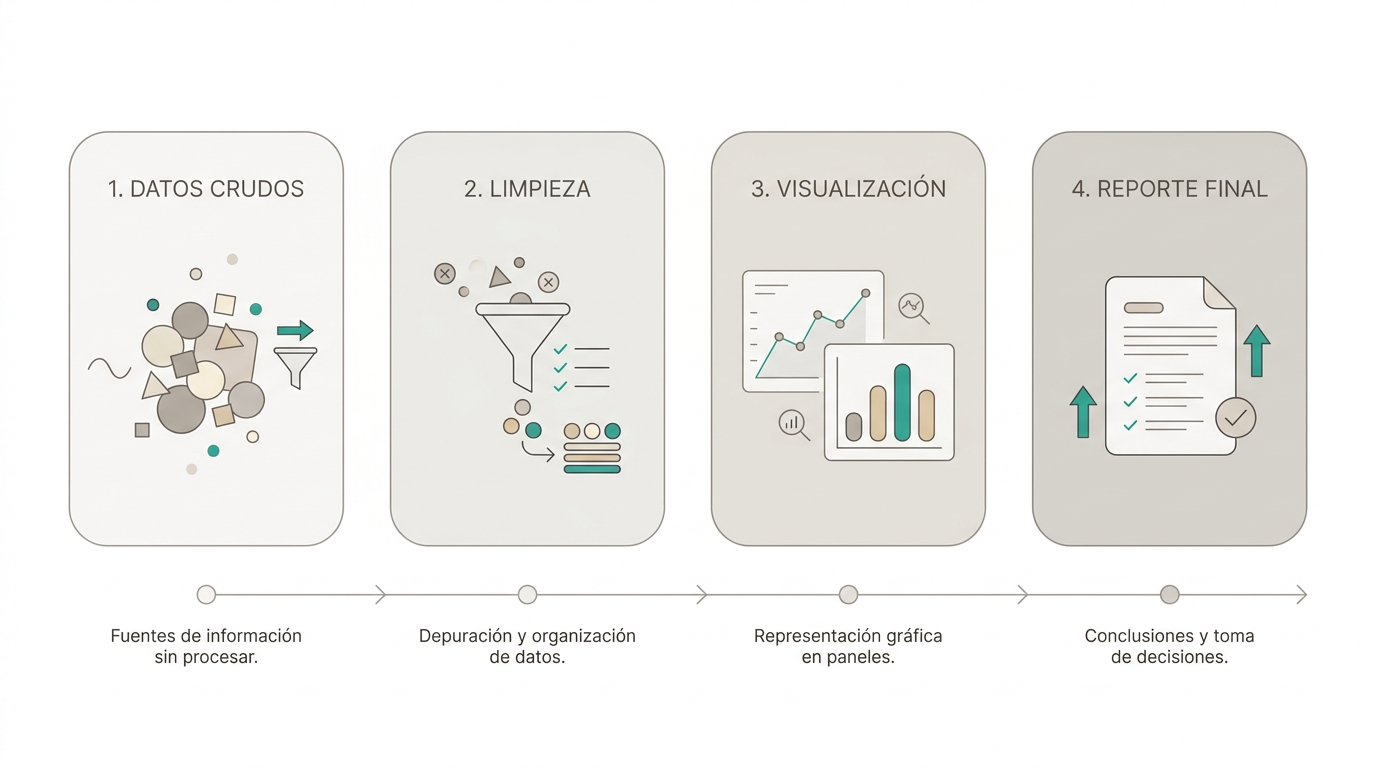
Data analysis. Three words that sound like someone in a lab coat staring at screens full of code. But analyzing data is something you already do every day, even if you don't call it that. Every time you compare this month's sales to last month's, you're doing data analysis. Every time you check the open rate of your latest email, same thing.
The difference between intuitive data analysis (what you already do) and systematic analysis isn't complexity — it's process. A process that lets you go from 'I think sales are dropping' to 'sales dropped 12% because we lost 3 large clients. Without those 3, the rest of the business grew 8%.'
In this guide I explain what data analysis is, the 4 types that exist, a step-by-step methodology, and today's tools that let you do all of this without writing a single line of code or hiring a data scientist.
What is data analysis?
Data analysis is the process of examining, cleaning, and transforming data with the goal of finding useful information, reaching conclusions, and supporting decision-making.
Plain-English definition: asking your data questions and getting answers you can use to make decisions.
The 4 types of data analysis
1. Descriptive Analysis — What happened?
The most basic level. Answers “what occurred?” Examples: monthly revenue, number of open tickets, quarterly churn rate, total website visits. Tools: dashboards, reports, summary tables.
2. Diagnostic Analysis — Why did it happen?
Explains the causes of what you saw in descriptive analysis. “Sales dropped 12% this month.” Diagnostic analysis investigates: are canceling customers from a specific segment? Did a competitor drop prices? Was there a product issue? Tools: segmentation, drill-down, correlations.
3. Predictive Analysis — What will happen?
Uses historical data to project future results. Example: with 12 months of pipeline and conversion rate data, will we hit next quarter’s revenue target? Tools: regression models, forecasting, machine learning.
4. Prescriptive Analysis — What should I do?
The most advanced level. Not only predicts what will happen but recommends concrete actions. Example: the system detects 3 large clients with declining usage patterns and recommends the CS team contact them before they cancel. Tools: AI, recommendation systems, decision automation.
Data analysis methodology in 5 steps
Step 1: Define the question. Start with a specific question, not “let’s see what I find.”
Step 2: Identify data sources. Where does the data live? CRM, database, Google Analytics, Google Sheets.
Step 3: Clean and prepare. 60-80% of analysis time. Raw data is dirty. Choose tools that automate this step.
Step 4: Analyze. Segment, compare periods, look for correlations. Go from general to specific.
Step 5: Communicate findings. To the CEO: 1 slide with main finding and 2 recommended actions. To the team: 1 dashboard with auto-updating data. To investors: 1 report with 6-month trend and market context.
No-code data analysis tools
| Tool | Best for | Price | Requires SQL? |
|---|---|---|---|
| RapidBoard | LATAM teams, AI dashboards | From USD 0 | No |
| Google Sheets | Simple analysis, collaboration | Free | No |
| Looker Studio | Google ecosystem dashboards | Free | No |
| Power BI | Microsoft enterprises, complex analysis | USD 10/user | Recommended |
| Tableau | Advanced visualization | USD 75/user | Recommended |
From data to decisions (without hiring an analyst)
The myth: you need a data scientist with a PhD in statistics.
The reality: with today’s tools, anyone who can ask business questions can do useful data analysis.
Simplified process:
- Connect your sources in a no-code tool
- Ask questions in plain English
- Get charts, tables, and visualizations automatically
- Share the dashboard with your team via a link
- Review weekly in team meetings
The barrier to entry for data analysis has never been lower. The only real barrier is knowing what questions to ask.
Get started today with
RapidBoard for your team
Early access is open. Join the first 100 spots and start making data-driven decisions faster.