Types of KPIs: a guide to choosing the right one
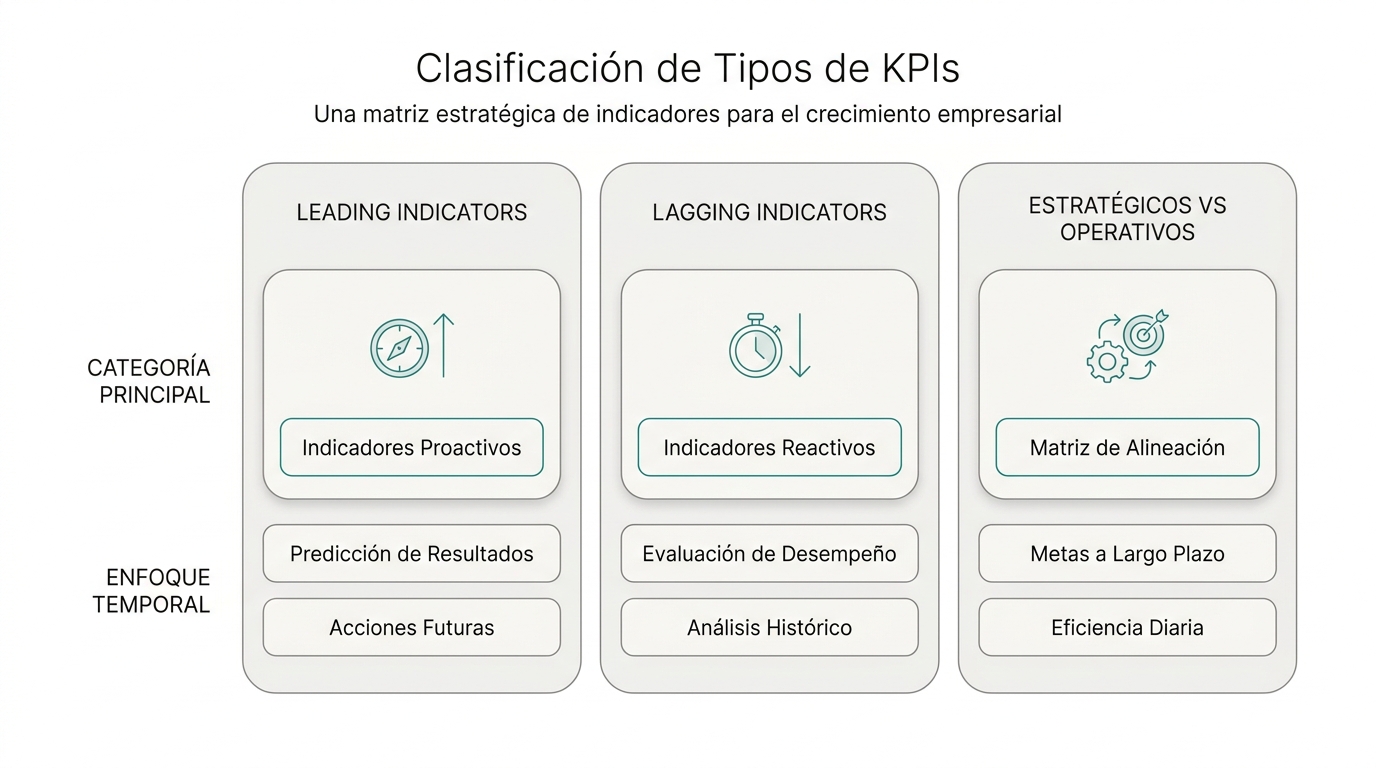
If you search 'types of KPIs' on Google, each article gives you a different classification. Some talk about quantitative vs qualitative KPIs. Others about strategic vs operational. The reality is there's no universal KPI taxonomy, but there are 4 classifications that appear in every data-driven team.
Knowing what type of KPI you're looking at isn't academic. It changes how you interpret it, how often you measure it, and what decisions you make with it.
The 4 KPI classifications you need to know
1. Strategic vs Operational KPIs
Strategic KPIs: Measure progress toward long-term company goals. Used by CEO, directors, and board.
- Frequency: monthly or quarterly
- Examples: YoY revenue growth, market share, global NPS, enterprise value
Operational KPIs: Measure day-to-day performance. Used by area managers and teams.
- Frequency: daily or weekly
- Examples: tickets closed today, leads generated this week, daily sales, average response time
2. Leading vs Lagging KPIs
Lagging KPIs: Measure results that already happened. Easy to measure but hard to change. By the time you see the number, the story already happened.
- Examples: last month’s revenue, quarterly churn rate, bugs found in production
Leading KPIs: Measure activities that predict future results. Harder to identify but more useful for decision-making.
- Examples: new pipeline opportunities (predicts revenue), completed onboarding sessions (predicts retention), sales cycle days (predicts closing velocity)
Rule of thumb: every lagging KPI should have at least one leading KPI that predicts it.
3. Financial vs Non-Financial KPIs
Financial KPIs: Everything measured in money — revenue, gross margin, EBITDA, cash flow, burn rate, ROAS. Audience: CFO, finance, investors.
Non-Financial KPIs: Everything else — NPS, customer satisfaction, response time, bugs resolved, candidates interviewed, leads generated. Audience: all teams.
4. Quantitative vs Qualitative KPIs
Quantitative KPIs: Measured with numbers. Objective and comparable — revenue, number of customers, tickets resolved, web sessions.
Qualitative KPIs: Measured with perceptions, opinions, or categories. NPS (converted to number), customer satisfaction, team engagement level, hiring quality.
Which KPI type does each level need?
| Level | KPI Type | Example | Frequency |
|---|---|---|---|
| CEO / Board | Strategic, Lagging, Financial | YoY Revenue, EBITDA, Market Share | Monthly |
| VP / Director | Strategic + Leading | Pipeline Generated, CAC, NPS | Weekly |
| Area Manager | Operational + Leading | Leads by Channel, Open Tickets, Turnover | Weekly |
| Team | Operational + Leading | Daily Sales, Bugs Resolved, Calls | Daily |
How to classify any KPI (quick matrix)
Answer these 4 questions:
- Who will use it? CEO → Strategic. Team → Operational.
- Past result or future predictor? Past → Lagging. Future → Leading.
- Expressed in money? Yes → Financial. No → Non-financial.
- Perception or number? Perception → Qualitative. Number → Quantitative.
A single KPI can be multiple things at once. “Lead to customer conversion rate” is strategic (VP Sales), operational (sales manager), leading (predicts revenue), non-financial, and quantitative.
Common mistakes
Mistake 1: Leading KPIs with no historical correlation. A leading KPI is only useful if proven to correlate with the lagging KPI it predicts.
Mistake 2: Only measuring lagging KPIs. Add at least one leading KPI for every lagging one.
Mistake 3: Confusing operational with strategic. That a KPI is important doesn’t make it strategic. “Tickets closed today” matters for support but the CEO shouldn’t be watching it.
Get started today with
RapidBoard for your team
Early access is open. Join the first 100 spots and start making data-driven decisions faster.